
When most people think about filters, it feels simple: dirty air goes in, clean air comes out. But behind that simplicity lies decades of science, engineering, and international testing.
Understanding how filters capture particles helps to separate guesswork from smart, future-proof choices—whether you’re running a hospital, a shopping mall, or keeping your own home safe and healthy.
The Science of Microparticles
The trickiest particle dimension for any filter to capture is called MPPS—the Most Penetrating Particle Size.
- For years, MPPS was assumed to be 0.3 microns.
- European EN 1822 standards narrow it to 0.1–0.2 microns.
- NASA studies go even further: 0.04–0.17 microns.
This is why filter testing is done at MPPS—if a filter can catch particles at their slipperiest size, it would also handle the rest.

Four Ways Filters Do Their Job
1. Mechanical Filtration (HEPA)
High Efficiency Particulate Air filters are known for their 99.97% efficiency at 0.3 microns. But there’s more to that:
- Below MPPS: Tiny particles bounce around randomly until they hit fibers. This is called diffusion.
- At MPPS: This is the toughest size—capture is lowest here.
- Above MPPS: Larger particles get stopped by interception—airflow brushes them into fibers—or impaction—they’re too heavy and slam right into fibers.
That’s why HEPA filters often exceed 99.99% efficiency for most particle sizes.
2. Chemical Filtration (Activated Carbon)
Mechanical filters can’t clear gases or odors. Activated carbon fills that gap.
- Surface area: up to 1,000 m² per gram.
- Handles: volatile chemicals like benzene, toluene, and everyday odors.
- Doesn’t handle: CO and CO₂, unless chemically treated.
Key point: carbon needs regular replacement to stay effective.
3. Electrical Filtration (Electrostatic)
Electrostatic technology charges particles, then traps them on plates with the opposite charge.
- Great for fine particles.
- Efficiency drops as plates get dirty.
- Poorly designed systems may generate trace ozone.
So design and maintenance of electrostatic filters matter.
4. Photochemical Filtration (UV-C)
UV-C light is the microbe killer. At 254 nm, it disrupts DNA and RNA in bacteria, viruses, and mold spores.
- Works best in dry conditions.
- Needs enough dwell time—air exposure.
- Doesn’t remove particles or gases—so it’s most powerful when combined with mechanical or chemical filtration.
Challenges in the Nordic climate
- Winter insulation traps highly vaporising chemicals—VOCs inside homes, offices, and malls.
- Wood-burning stoves add fine particles to indoor air.
- Swimming pools and spas create moist environments ripe for biological growth.
- Factories and manufacturing facilities need specialized protection against dust, fumes, and vapors.
That’s why smart buildings mix and match technologies—HEPA for particles, carbon for gases, UV-C for microbes. These filter combinations create healthier, more sustainable environments.
Verifying Efficiency Claims
Filter performance needs to be proven. Certified filters are tested to meet global standards:
- ASHRAE 52.2 → MERV ratings, particle-size efficiency.
- EN 1822 → Europe’s HEPA benchmark, focusing on MPPS.
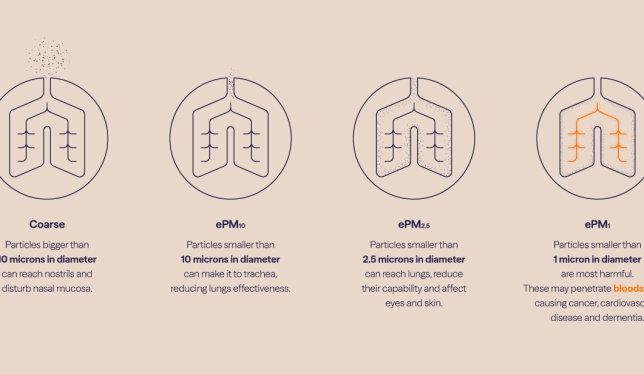
- ISO 16890 → Classifies filters by efficiency against PM1, PM2.5, PM10.
These standards make sure that the claim of 99.97% efficiency is valid.
The Takeaway
Air filtration combines physics, chemistry, and biology—working together to keep people healthy, buildings efficient, and equipment protected.
If you’re a property manager, an industrial operator, or a property owner, then there’s more to the right mix of filters than just cleaning the air:
- Filtered air boosts occupant health and comfort.
- It cuts energy consumption and equipment wear.
- Keeps you compliant with international regulations.
///
Abbreviations
MPPS – Most Penetrating Particle Size
HEPA – High-Efficiency Particulate Air
VOC – Volatile Organic Compounds
UV-C – Ultraviolet-C light (germicidal range)
ASHRAE – American Society of Heating, Refrigerating and Air-Conditioning Engineers
MERV – Minimum Efficiency Reporting Value- ISO – International Organization for Standardization
EN – European Norm (standards)